“Nationality” and “citizenship” are not synonymous terms..” Miller v. Albright, 523 U.S. 420 (1998).
A man/woman cannot owe allegiance to all the states (United States) since they are defined as separate countries. The ‘United
States’ is not a single country or nation (but is a society) under the principles of International Law but a federation of countries.
See: “Country” - is meant the STATE of which one is a member. Bouvier's Law Dict. (1856)).
The term “Union States”, define each State in the American union as a separate ‘nation’.
See also: “Persons claiming American citizenship merely by birth location may pay no allegiance to America”. 14 Tex.
Wesleyan Law Review. 337, Spring 2008; Elk v Wilkins, 112 U.S. 94 (1884).
2. Nationality is a guaranteed ‘Natural Right’ by virtue of International law and the Law of Nations. Bouvier's (6th 1856), defines “nationality” as, "The state of a person in relation to the nation in which he was
born. A man retains his nationality of origin during his minority, in the case of his domicile of origin, he may change his nationality upon attaining full age".
The U.S. Congress made federal nationality and citizenship a voluntary political choice in order not to infringe upon human being's natural rights in 1868.
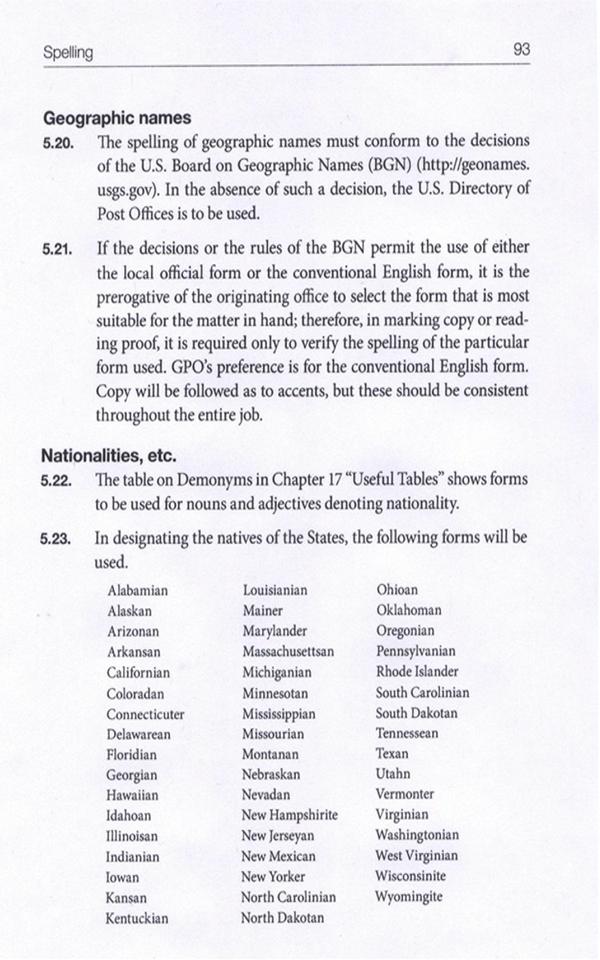
The INS does not list the nationalities of the several states of the American union on the website; although enumerated in the U.S. Style Manual (1984), lists the ‘nationalities of the states’ in Chapter 5.22, 5.23 on page 93. The “Law of Nations” is a part of the laws of the United States, U.S. v. Ravara, 2 U.S. 297 (1793).
3. The term “Nationality” is relative to “nation” and means “quality or character which arises from the fact of a person's belonging to a nation or state.” [e.g. 8 U.S.C. 1101 (a)(21), Black’s Law 4th Ed., pg. 1176 and nationality" is opposed to "territoriality," of distinguishing a nation having no national territory; 8 Say. Syst. sec. 346; Westl. Private Intrnl
Law, 5.
The term "national" means a State national who is not a U.S. citizen nor is a member of the public de facto. A (non-U.S.)[State] “National” defined as “a person owing permanent allegiance to a state” pursuant to 8 USC 1101(a)(21); 3C AmJur 2732-37
[purpose of Immigration and Nationality Act], and defined by the I.R.S. under 26 U.S.C. 152.
The term “Union states”, means each state in the American union is a separate ‘nation’. There is absolutely nothing in the “Federal Constitution” that negates this fact. “Country” is defined as
“By country is meant the STATE of which one is a member. Bouvier's (1856). The term “Character” means “Class or division to which claim belongs”. Black’s 4th ed. pg. 294.