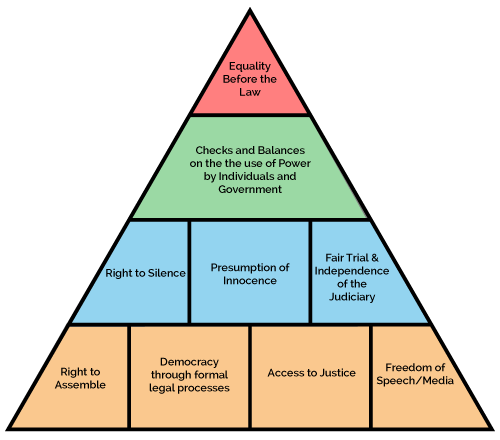
Stick with the Rule of Law

Published: Sat, 06/20/15

The rule of law is the legal principle that law should govern a nation, as opposed to being governed by arbitrary decisions of individual government officials. It primarily refers to the influence and authority of law within society, particularly as a constraint upon behavior, including behavior of government officials.[2] The phrase can be traced back to 16th century England, and it was popularized in the 19th century by British jurist A. V. Dicey. The concept was familiar to ancient philosophers such as Aristotle, who wrote "Law should govern".

Rule of law implies that every citizen is subject to the law, including law makers themselves. In this sense, it stands in contrast to an autocracy, collective leadership, dictatorship, or oligarchy where the rulers are held above the law. Lack of the rule of law can be found in both democracies and dictatorships, for example because of neglect or ignorance of the law, and the rule of law is more apt to decay if a government has insufficient corrective mechanisms for restoring it. Government based upon the latter is called monocracy. https://en.wikipedia.org/wiki/Rule_of_law


Legal Definition of the "Rule of Law"
Rule according to law; rule under law; or rule according to a higher law.
The rule of law is an ambiguous term that can mean different things in different contexts. In one context the term means rule according to law. No individual can be ordered by the government to pay civil damages or suffer criminal punishment except in strict accordance with well-established and clearly defined laws and procedures. In a second context the term means rule under law. No branch of government is above the law, and no public official may act arbitrarily or unilaterally outside the law. In a third context the term means rule according to a higher law. No written law may be enforced by the government unless it conforms with certain unwritten, universal principles of fairness, morality, and justice that transcend human legal systems. 
Good reading see more at: