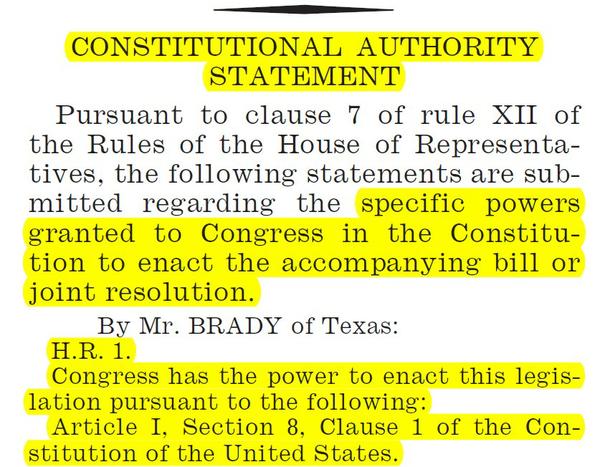
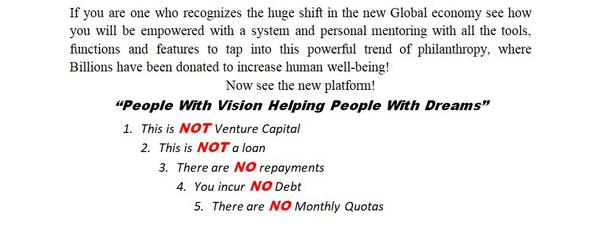
Thanks to Don Grahn, he brought this to my attention and I think it is very important information. Don said that this This Constitutional Authority Statement rule was originated in 2011. So it wasn’t difficult to find this attachment as well as others to validate that if Congress has to validate in constitutionality of a statute,
in my opinion, the judge will have no wiggle room. |
I also give thanks to Obama and the Democrats for being so corrupt and evil that it has created an awakening to a NEW REVOLUTION that you are on the horizon of a new beginning… thank you Jesus!!!!!!!!!!!!!!!! |
On January 5, 2011, the House of Representatives adopted an amendment to House Rule XII to require that Members of the House state the constitutional basis for Congress’s power to enact the proposed legislation when
introducing a bill or joint resolution. This Constitutional Authority Statement (CAS) rule, found at House Rule XII, clause 7(c), was subsequently adopted in the 113th , 114th, and 115th Congresses.
Understanding the CAS rule first requires an understanding of both the powers provided to the Congress under the Constitution and Congress’s role in interpreting the
founding document.
In the attachment is a document well worth your time reading, because you will find that the most common means of complying with the rule is to cite to a specific clause in Article I, Section 8, such as the Taxing and Spending Clause. “BINGO”
The supreme Court as well as the lower courts all agree the the statutory interpretation, to wit: We begin our analysis with the language of the statute. See, e.g., Barnhart v. Sigmon Coal Co., Inc., 534 U.S. 438, 122 S.Ct. 941, 950, 151 L.Ed.2d 908 (2002). "Our first
step in interpreting a statute is to determine whether the language at issue has a plain and unambiguous meaning with regard to the particular dispute in the case. Our inquiry must cease if the statutory language is unambiguous and `the statutory scheme is coherent and consistent.'" Robinson v. Shell Oil Co., 519 U.S. 337, 340, 117 S.Ct. 843, 846, 136 L.Ed.2d 808 (1997) (quoting United States v. Ron Pair Enterprises, Inc., 489 U.S. 235, 240, 109 S.Ct. 1026, 1030, 103 L.Ed.2d
290 (1989)). In determining the "plainness or ambiguity of statutory language" we refer to "the language itself, the specific context in which that language is used, and the broader context of the statute as a whole." Id. at 341, 117 S.Ct. at 846 (citing Estate of Cowart v. Nicklos Drilling Co., 505 U.S. 469, 477, 112 S.Ct. 2589, 2595, 120 L.Ed.2d 379 (1992); McCarthy v. Bronson, 500 U.S. 136, 139, 111 S.Ct. 1737, 1740, 114 L.Ed.2d 194 (1991)).
|
|
Christopher Chapman
WAKE UP
AMERICANS
321.264.6383
americanliberties.llc@gmail.com
Help us, to help you, to help others to help Americans |
|
|