THE FIFTH U.S. CIRCUIT COURT OF APPEALS has issued a stunning ruling admitting that the United States and the federal courts have been systematically misapplying the income tax as a non-apportioned direct tax for decades. The clear implication is that literally trillions of dollars have been
improperly taken from their rightful owners.
The further implication is that hundreds of men and women-- perhaps even thousands-- have been victims of legal harassment and intimidation, property seizures, character assassination and even imprisonment, all based on a fraud. At the same time, it is clear that the explosive (and, some would say, republic-eroding) growth of the federal government over the same period has been financed by this same
scheme.
THE PARADIGM-SHATTERING ADMISSION by the panel of the circuit court (which has since been replicated in other circuits, as well) came in a ruling reported as Parker v. Comm'r, 724 F.2d 469. Alton Parker, an otherwise unremarkable "Fifth
Amendment" tax protestor, had appealed a Tax Court decision finding him liable for taxes on conceded taxable activity.
In the appellate court, Parker raised an additional argument beyond the confused notion that completing a tax form amounted to "self-incrimination". Parker also squarely challenged the appellate court with the assertion that, as put by the panel, "the IRS and the government in general, including the judiciary, mistakenly interpret the
sixteenth amendment as allowing a direct tax on property (wages, salaries, commissions, etc.) without apportionment."
The circuit court panel found itself unable to dispute Parker's allegation, and ultimately admitted its accuracy.
THE ADMISSION BY THE COURT IS (perhaps unsurprisingly) circumspectly and even deceptively made. It takes the form of a complete misrepresentation of an old (but still standing and
widely-cited) ruling by the U.S. Supreme Court, declaring the high court to have said exactly the opposite of what it actually says. (See the misrepresentation, and what the Supreme Court actually says, here.)
Despite the awkwardness of this approach, however, the circuit court's evasion of Parker's
allegation constitutes a definitive admission of its accuracy under routine principles of law. As the Supreme Court puts it,
"Indeed, as Mr. Justice Brandeis declared, speaking for a unanimous court in the Tod case, supra, which involved a deportation: "Silence is often evidence of the most persuasive character." 263 U.S. at 263 U. S. 153-154. And just last Term, in Hale, supra, the Court recognized that
"[f]ailure to contest an assertion . . . is considered evidence of acquiescence . . . if it would have been natural under the circumstances to object to the assertion in question." 422 U.S. at 422 U. S. 176. [footnote 3]."
Baxter v. Palmigiano, 425 U.S.
308, 318 (1976)
Plainly, an outright falsehood in response to an assertion is the equivalent of silence as meant in these statements of the law by the high court. In fact, falsehood such as that resorted-to by the Fifth Circuit panel simply makes clear that the circuit court recognized its duty to have validly objected to the assertion presented had it been able to do so, thus making its failure to do so that much more plainly an admission of the
assertion's accuracy.
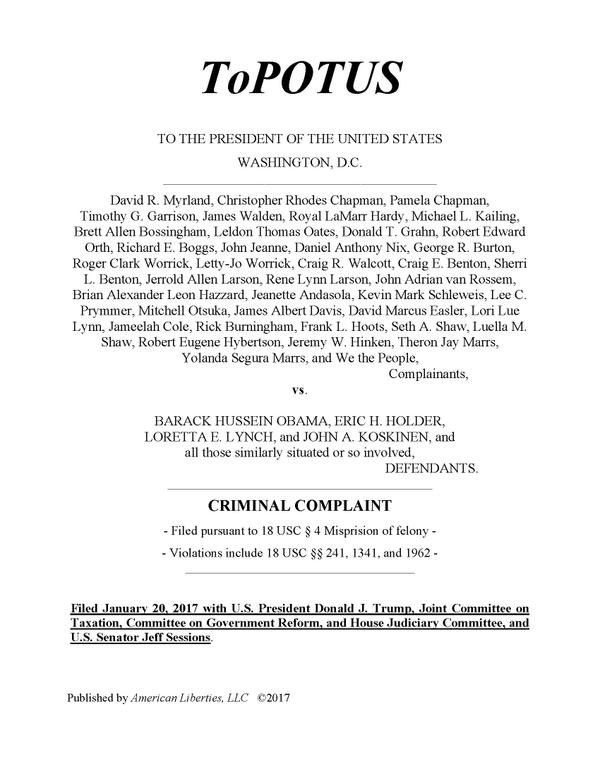
IT IS IMPOSSIBLE TO PREDICT how extensively the Parker court's admission of the misapplication of the income tax will be called-upon in legal actions for redress sure to come from victims of what is now acknowledged to have been abusive-- if not criminal-- behavior by government, tax agency, and judicial officials under the auspices of tax law. No doubt the clamor will be very loud indeed.
###
NOTE: I posted all the evidence of the Parker court admission discussed above here, two days ago (and at that, just a week after posting an in-depth exposé of a long-running IRS fraud about "frivolous return penalties"). The internet generally, and all social media, should be BURIED in articles like the one above by now. Where's yours?
Where are the products of your scramble to discover and expose other instances of courts running the same scam, and making the same effective admission, as the Parker court?