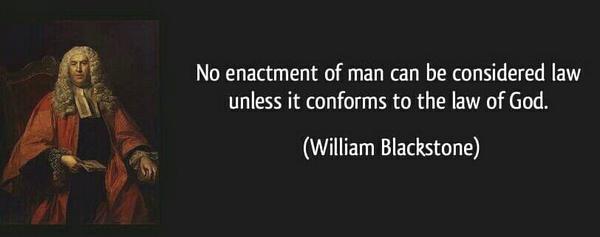
For any government, federal or state, any court, any law to deny the existence of God, this would clearly oppose and be in direct conflict with the Declaration of Independence, the Federal Constitution and each state’s constitution that one’s rights are unalienable that are endowed by our Creator
and well as other public laws, Presidential executive orders including international constitutions of foreign countries. "Laws of nature and of nature's God”, “unalienable rights endowed by our Creator” in Declaration of Independence. See: Blackstone Commentaries Vol. I, "Of the Rights of Persons," at 41 (1765)] (ref: “absolute rights.”) "This law of nature, being co-eval with mankind and dictated by God himself, is of course superior in obligation to any other. It is
binding over all the globe, in all countries, and at all times: no human laws are of any validity if contrary to this; upon these two foundations, the law of nature and the law of revelation, depend all human laws; that is to say, no human laws should be suffered to contradict these".
U.S. law and U.S. Public Policy recognizes “Natural law” “Laws of Nature”;“Nature's God”; Holy Scriptures; by Natural, Endowed, and Inherent, Rights “endowed by our Creator” as declared by the Declaration of Independence and re-affirmed by U.S. Congress pursuant to Executive Presidential order (Reagan) PUBLIC LAW 97-280 on 9/04/1982 “the
Holy Bible is Word of God” and Executive Order 6100, EO 6100 (2/22/1990) Pres. Bush – “International year of bible reading” and The International Religious Freedom Act of 1998 and The Universal Declaration of Human Rights, December 10, 1948 the General Assembly of the United Nations adopted and proclaimed the Universal Declaration of Human Rights.
Furthermore, under International law under The International Religious Freedom Act of 1998. Sec. 2. Finding; Policy. [22 USC 6401 (a) Findings.‑‑Congress makes the following findings: (2) Freedom of religious belief and practice is a universal human right and fundamental freedom articulated in numerous international
instruments, including the Universal Declaration of Human Rights, the International Covenant on Civil and Political Rights, the Helsinki Accords, the Declaration on the Elimination of All Forms of Intolerance and Discrimination Based on Religion or Belief, the United Nations Charter, the European Convention for the Protection of Human Rights and Fundamental Freedoms.
(Article 18(3) of the Universal Declaration of Human Rights (UDHR) recognizes that ``Everyone has the right to freedom of thought, conscience, and religion. This right includes freedom to change his religion or belief, and freedom, either alone or in community with others and in public or private, to
manifest his religion or belief in teaching, practice, worship, and observance.''.
Article 18(1) of the International Covenant on Civil and Political Rights recognizes that ``Everyone shall have the right to freedom of thought, conscience, and religion. This right shall include freedom to have or to adopt a religion or belief of his choice, and freedom, either individually or in
community with others and in public or private, to manifest his religion or belief in worship, observance, practice, and teaching''. Governments have the responsibility to protect the fundamental rights of their citizens and to pursue justice for all. Religious freedom is a fundamental right of every individual, regardless of race, sex, country, creed, or nationality, and should never be arbitrarily abridged by any government.