CRIMINAL RESOURCE MANUAL(CRM)
662. MARITIME, TERRITORIAL AND INDIAN JURISDICTION -- GENERALLY; 664. TERRITORIAL
JURISDICTION;
665. DETERMINING FEDERAL JURISDICTION;
666. PROOF OF TERRITORIAL JURISDICTION, these section in the CRM quotes statutes but not 18 USC §3231
662. MARITIME, TERRITORIAL AND INDIAN JURISDICTION --
GENERALLY
Jurisdiction over most personal and property crimes within our Federal system is vested in the states. The Federal government enacts criminal laws primarily for the protection of its own functions (e.g., 18 U.S.C. § 1001); personnel (e.g., 18 U.S.C. § 1114); and property (e.g., 18 U.S.C. § 641). It intrudes into the area generally left to the states only where special circumstances warrant its providing
auxiliary law enforcement assistance to the states unable to act beyond their borders (e.g., 18 U.S.C. §§ 659, 2113, 2314). For Federal jurisdiction to exist, the underlying conduct must be based upon or linked to some "nexus," such as use of the mail, 18 U.S.C. § 1341, interstate commerce, 18 U.S.C. § 2314, or Federal insurance, 18 U.S.C. § 2113.
There are, in addition, certain
instances in which the special relationship the United States Government bears to the site of the offense provides the rationale and basis for the exercise of plenary criminal jurisdiction. It is with this latter class of offenses that this chapter is concerned.
664. TERRITORIAL JURISDICTION
Of the several categories listed in 18 U.S.C. § 7, Section 7(3) is the most significant, and provides:
The term "special maritime and territorial jurisdiction of the United States," as used in this title, includes: . . .
(3) Any lands reserved or acquired for the use of the United States, and under
the exclusive or concurrent jurisdiction thereof, or any place purchased or otherwise acquired by the United States by consent of the legislature of the State in which the same shall be, for the erection of a fort, magazine, arsenal, dockyard, or other needful building.
As is readily apparent, this subsection, and particularly its second clause, bears a striking resemblance to the 17th
Clause of Article I, Sec. 8 of the Constitution. This clause provides:
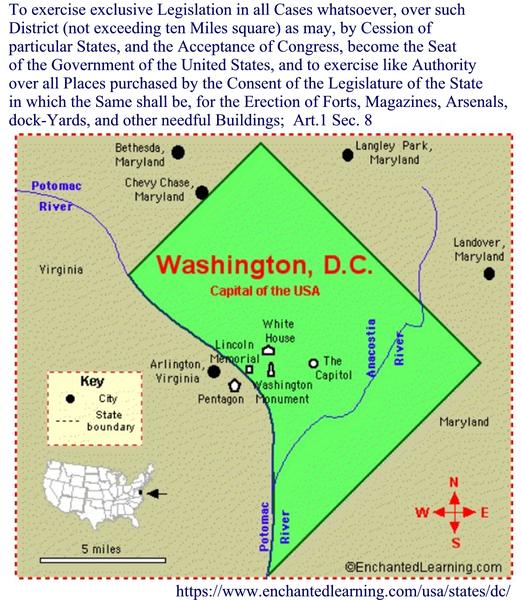
The Congress shall have power. . . To exercise exclusive Legislation in all Cases whatsoever, over such District (not exceeding ten Miles square) as may, be Cession of particular States, and the acceptance of Congress, become the Seat of the Government of the United States, and to exercise like Authority over all
Places purchased by the Consent of the Legislature of the State in which the Same shall be, for the Erection of Forts, Magazines, Arsenals, dock-Yards, and other needful Buildings.
(Emphasis added.) The constitutional phrase "exclusive legislation" is the equivalent of the statutory expression "exclusive jurisdiction." See James v. Dravo Contracting Co., 302 U.S. 134, 141 (1937), citing, Surplus Trading
Co. v. Cook, 281 U.S. 647, 652 (1930).
Until the decision in Dravo, it had been generally accepted that when the United States acquired property with the consent of the state for any of the enumerated purposes, it acquired exclusive jurisdiction by operation of law, and any reservation of authority by the state, other than the right to serve civil and criminal
process, was inoperable. See Surplus Trading Co. v. Cook, 281 U.S. at 652-56. When Dravo held that a state might reserve legislative authority, e.g., the right to levy certain taxes, so long as that did not interfere with the United States' governmental functions, it became necessary for Congress to amend 18 U.S.C. § 7(3), by adding the words "so as," to restore criminal jurisdiction over those places previously believed to be under exclusive Federal legislative
jurisdiction. See H.R. Rep. No. 1623, 76th Cong., 3d Sess. 1 (1940); S. Rep. No. 1788, 76th Cong., 3d Sess. 1 (1940).
Dravo also settled that the phrase "other needful building" was not to be strictly construed to include only military and naval structures, but was to be construed as "embracing whatever structures are found to be necessary in the performance of the function of
the Federal Government." See James v. Dravo Contracting Co., 302 U.S. at 142-43. It therefore properly embraces courthouses, customs houses, post offices and locks and dams for navigation purposes.
The "structures" limitation does not, however, prevent the United States from holding or acquiring and having jurisdiction over land acquired for other valid purposes, such as
parks and irrigation projects since Clause 17 is not the exclusive method of obtaining jurisdiction. The United States may also obtain jurisdiction by reserving it when sovereign title is transferred to the state upon its entry into the Union or by cession of jurisdiction after the United States has otherwise acquired the property. See Collins v. Yosemite Park Co., 304 U.S. 518, 529-30 (1938); James v. Dravo Contracting Co., 302 U.S. at 142; Surplus Trading Co.
v. Cook, 281 U.S. at 650-52; Fort Leavenworth R.R. Co. v. Lowe, 114 U.S. 525, 526-27, 538, 539 (1885).
The United States may hold or acquire property within the borders of a state without acquiring jurisdiction. It may acquire title to land necessary for the performance of its functions by purchase or eminent domain without the state's consent. See Kohl v.
United States, 91 U.S. 367, 371, 372 (1976). But it does not thereby acquire legislative jurisdiction by virtue of its proprietorship. The acquisition of jurisdiction is dependent on the consent of or cession of jurisdiction by the state. See Mason Co. v. Tax Commission, 302 U.S. 97 (1937); James v. Dravo Contracting Co., 302 U.S. at 141-42.
State
consent to the exercise of Federal jurisdiction may be evidenced by a specific enactment or by general constitutional or statutory provision. Cession of jurisdiction by the state also requires acceptance by the United States. See Adams v. United States, 319 U.S. 312 (1943); Surplus Trading Co. v. Cook, 281 U.S. at 651-52. Whether or not the United States has jurisdiction is a Federal question. See Mason Co. v. Tax Commission, 302 U.S. at
197.
Prior to February 1,1940, it was presumed that the United States accepted jurisdiction whenever the state offered it because the donation was deemed a benefit. See Fort Leavenworth R.R. Co. v. Lowe, 114 U.S. at 528. This presumption was reversed by enactment of the Act of February 1, 1940, codified at 40 U.S.C. § 255. This statute requires the head or
authorized officer of the agency acquiring or holding property to file with the state a formal acceptance of such "jurisdiction, exclusive or partial as he may deem desirable," and further provides that in the absence of such filing "it shall be conclusively presumed that no such jurisdiction has been acquired." See Adams v. United States, 319 U.S. 312 (district court is without jurisdiction to prosecute soldiers for rape committed on an army base prior to filing of
acceptance prescribed by statute). The requirement of 40 U.S.C. § 255 can also be fulfilled by any filing satisfying state law. United States v. Johnson, 994 F.2d 980, 984-86 (2d Cir. 1993). The enactment of 40 U.S.C. § 255 did not retroactively affect jurisdiction previously acquired. See Markham v. United States, 215 F.2d 56 (4th Cir.), cert. denied, 348 U.S. 939 (1954); United States v. Heard, 270 F. Supp. 198, 200 (W.D. Mo. 1967).
COMMENT: In summary, the United States may exercise plenary criminal jurisdiction over lands within state borders:
- Where it reserved such jurisdiction upon entry of the state into the union;
- Where, prior to
February 1, 1940, it acquired property for a purpose enumerated in the Constitution with the consent of the state;
- Where it acquired property whether by purchase, gift or eminent domain, and thereafter, but prior to February 1, 1940, received a cession of jurisdiction from the state; and
- Where it acquired the property, and/or received the state's
consent or cession of jurisdiction after February 1, 1940, and has filed the requisite acceptance.
665. DETERMINING FEDERAL JURISDICTION
When instances are reported to the United States Attorney of offenses committed on land or in buildings occupied by agencies of the Federal government --
unless the crime reported is a Federal offense regardless of where committed, such as assault on a Federal officer or possession of narcotics -- the United States has jurisdiction only if the land or building is within the special territorial jurisdiction of the United States.
PRACTICE TIP: A convenient method of determining the jurisdictional status is to contact an appropriate
attorney with the agency having custody of the land. If the land is other than a military base, the regional counsel's office of the General Services Administration usually has the complete roster of all Federal lands and buildings in its region and can frequently provide a definitive answer to jurisdiction. If the land in question is part of a military base, contact with the post Staff Judge Advocate may be helpful. If the military personnel in the field or the field attorneys of the agency
having responsibility for the land are unable to render assistance, the Office of Enforcement Operations of the Criminal Division should be called. Each United States Attorney would be well advised to request from each agency within the district a report on the jurisdictional status claimed for each of its facilities and assurance that documentation is available.
666. PROOF OF
TERRITORIAL JURISDICTION
There has been a trend to treat certain "jurisdictional facts" that do not bear on guilt (mens rea or actus reus) as non-elements of the offense, and therefore as issues for the court rather than the jury, and to require proof by only a preponderance that the offense was committed in the territorial jurisdiction of the court to establish that venue has been properly laid. See United
States v. Bowers, 660 F.2d 527, 531 (5th Cir. 1981); Government of Canal Zone v. Burjan, 596 F.2d 690, 694 (5th Cir. 1979); United States v. Black Cloud, 590 F.2d 270 (8th Cir. 1979) (jury question); United States v. Powell, 498 F.2d 890, 891 (9th Cir. 1974). The court in Government of Canal Zone v. Burjan, 596 F.2d at 694-95, applied the preponderance test to determinations of whether or not the offenses took place within the
Canal Zone which established not merely proper venue but subject matter jurisdiction as well. Other cases, however, hold that the issue of whether the United States has jurisdiction over the site of a crime is a judicial question, see United States v. Jones, 480 F.2d 1135, 1138 (2d Cir. 1973), but that the issue of whether the act was committed within the borders of the Federal enclave is for the jury and must be established beyond a reasonable doubt. See United States v.
Parker, 622 F.2d 298 (8th Cir. 1980); United States v. Jones, 480 F.2d at 1138. The law of your Circuit must be consulted to determine which approach is followed in your district.
The decision in Burjan should be viewed with caution. The analogy between territorial jurisdiction and venue has much to recommend it. Nevertheless, it is important to recognize that the
two are not of equal importance. As the Burjan court noted, citing Fed. R. Crim. P. 12, subject matter jurisdiction is so important that it cannot be waived and may be noticed at any stage of the proceeding, see Government of the Canal Zone v. Burjan, 596 F.2d at 693, whereas the Ninth Circuit in Powell rested its ruling that venue need be proved by only a preponderance on the relative unimportance of venue as evidenced by its waivability. There is a clear distinction between the
question of which court of a sovereign may try an accused for a violation of its laws and whether the sovereign's law has been violated at all.
Proof of territorial jurisdiction may be by direct or circumstantial evidence, and at least at the trial level may be aided by judicial notice. See United States Bowers, 660 F.2d at 530-31; Government of Canal Zone v.
Burjan, 596 F.2d at 694. Compare Government of Canal Zone v. Burjan, 596 F.2d 690 with United States v. Jones, 480 F.2d 1135, concerning the role judicial notice may play on appeal.
Join our self funding for American Liberties.