1. one as being spiritually dead relating to a ‘natural man’ as one who is not ‘born again’. See: 1 Corinthians 2:14.
“Now the natural man does not receive the things of the Spirit of God, for they are foolishness to him, he cannot understand them, because they are spiritually discerned”.
2. These words describe the ‘old man’ or ‘nature’ or ‘natural person’, but not the ‘new man' or ‘new nature’ by being ‘born again’ by grace through faith in Jesus. See: Colossians 3:10.
See: “and have clothed yourselves with the new nature, new man, which is being renewed in full knowledge, consistent with the image of the Creator who created it”; See Also: “Do not be conformed to this world, but be transformed by the renewing of your mind. Then you will be able to discern what is the good, pleasing, and perfect will of God”. Romans 12:2
3. The term "Natural man” is defined as “unenlightened or unregenerate". “Unregenerate” means "not regenerate; unrepentant; an unregenerate sinner; not convinced by or unconverted to a particular religion; wicked, sinful, dissolute". Random House Dictionary of the English Language, 2nd Ed., pg. 1461.
4. A ‘Human Being’ is defined as a "Natural man as unenlightened or unregenerate". Random House Dictionary of the English Language, 2nd Ed., pg. 901.
5. The term ‘*Human Being’ is defined as a ‘Monster’ means "a human being by birth, but in part resembling a lower animal”. Balantine’s Self Pronouncing Law Dict. (1948), pg. 389.
The term 'human being' is not found anywhere in Holy Scriptures and is not synonymous with a sentiment “man / woman”. A “Human being” [Humanus] originated by the Vatican under the 14th century Papal Decree as, “a ‘lesser/inferior man or woman’ defined legally as an ‘animal’ and/or ‘monster’ as distinct from the ancient” not subject to the laws of free men, but the laws of property”. See: ‘secular’, “unbaptized indigenous populations”, 'unregenerate', ‘unrepentant’, ‘humanitarian’. The doctrine
attributed to Pope Innocent IV, of the creation of the term “persona ficta”, an inheritance from the Roman law also called juridical persons, juristic, artificial, or fictitious persons. See: ‘condition’.
6. A ‘Monster’ is defined as "a person so cruel, wicked, depraved, etc., as to horrify others”. Webster's New World Dictionary, 3rd College Ed. (1988), pgs. 879-880.
7. The term ‘Humanitarianism’ is defined as "the doctrine that humankind may become perfect without divine aid." Webster's New World Dictionary, 3rd College Ed., (1988), pg. 657. Also means "a philanthropist; an anti-Trinitarian who rejects the doctrine of Christ’s divinity; a perfectionist." Colliers New Dictionary of the English Language, (1928).
8. The term ‘Humanism’ is defined as "any system or mode of thought or action in which human interests, values and dignity predominate, an ethical theory that rejects the importance of a belief in God." Random House Webster's College Dictionary, (1990) pg 653.
1 Timothy 1:9 "We also know that the law is made not for the righteous but for lawbreakers and rebels, the ungodly and sinful, the unholy and irreligious, for those who kill their fathers or mothers, for murderers",
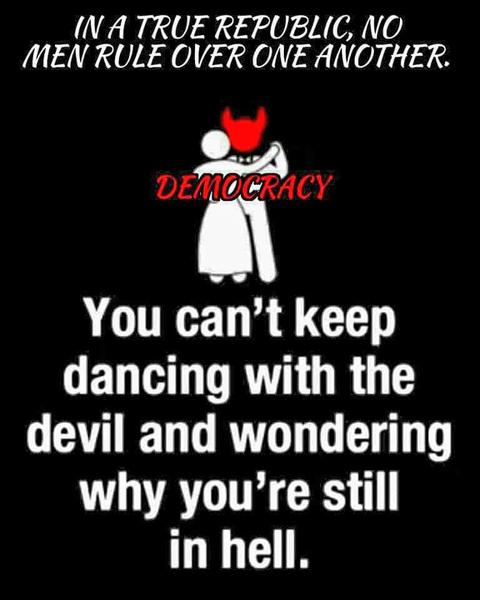
America has never had a true republic
In a true republic, you have the right to decide for yourself the difference between right and wrong according to your God given conscience and be answerable to God. But if you live by the laws of men by swearing oaths by the laws of man then men will regulate your rights. If your rights come by the laws of men that they create then they will regulate your rights and your life. But if your rights come from God then God will regulate
your rights and life. Any man that opposing God then will answer to God.
The U.S. Constitution guarantees a ‘republic form of government’, Art. 4, §4.
The word “Republic” of the Latin idiom, “Libera Res Publica” - “free from all things public”. This fact has been stricken from all American history books and found in European history books. The original republic was one in which a freeman was free from all civil authority and religiously allowed to accept or reject his God as King. The heads of governments were “titular” in authority and in name only. Israel was one of the first
republican governments run entirely by freewill offerings and free assemblies. Moses was the leader of the Hebrew people but not their ruler which he could have chosen to be.
In a true republic, no man has authority over another man. This changed when the Hebrews wanted an earthly ruler (Saul). God said (8) “they have rejected of Me”. 1 Samuel 8:7-19.
FREE - Not subject to legal constraint of another. Unconstrained; having power to follow the dictates of his own will. Not subject to the dominion of another. Not compelled to involuntary servitude. Used in this sense as opposed to "slave." Black’s 4th, pg. 471.
FREEDOM - The state of being free; liberty; self-determination [1]; absence of restraint; the opposite of slavery. The power of acting, in the character of a moral personality, according to the dictates of the will, without other check, hindrance, or prohibition than such as may be imposed by just and necessary laws and the duties of social life. Black’s 4th, pg. 472.
Laws of Nations, §4 - Nation composed of men naturally free & independent and who, before the establishment of civil societies, lived together in the state of nature[2]. (Mayflower Compact).